Camping Holiday In Alentejo - Alan Rogers
4 campsites in Portugal, Alentejo for Portalegre
Campsite Listing Google Map
The following consent is required:
Tracking & performance, Targeting & advertising.

No campsites match your search terms.
Alentejo
With huge, sparsely populated plains dominated by vast cork plantations, which provide nearly half of the world’s cork, Alentejo’s main attractions include the historic city of Évora and the coastal resorts with their fine, sandy beaches.
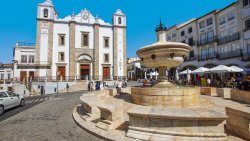
One of the most impressive cities in Portugal, Évora lies on a gently sloping hill rising out of the huge Alentejo plain. A city steeped in history, the Romans and Moors occupied it for centuries. With its narrow streets of Moorish origin and white-washed houses, it also boasts one of the best-preserved Roman temples in the country, plus various palaces and monuments, the majority dating from the 14th-16th centuries.
One of the more extraordinary sights can be found in the Capela dos Ossos in the church of São Francisco; adorning the walls and pillars of this chamber are the bones of more than 5,000 monks. On the Alentejo coast is the small, peaceful town of Santiago do Cacém, which has two of the best beaches in Portugal. The nearby archaeological site at Miróbriga includes ruins of a hippodrome, several houses (some of which have mural paintings) and a clearly defined acropolis. Further south along the coast is Porto Côvo and the larger, popular resort of Vila Nova de Milfontes, which has a little castle and ancient port.
Alentejo is made up of four districts: Beja, Évora, Setubal, and Portalegre.
Places of interest
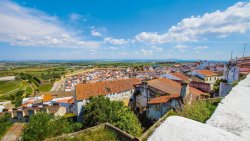
Arraiolos: Ancient town, 17th-century castle, famous for its carpets.
Beja: Provincial town founded by Julius Caesar, 13th-century castle.
Borba: Pretty town, noted for its marble and wine.
Elvas: Ancient fortress town, 15th-century aqueduct.
Estremoz: A market town, medieval castle.
Odemira: A quiet, characterful country town.
Reguengos de Monsaraz: A charming, unspoiled village with white-washed houses.
Vila Viçosa: An attractive hillside town, 16th-century convent.
Cuisine of the region
Alentejo was traditionally an important wheat-growing region (it is frequently referred to as the ‘granary of Portugal’). Local specialities include sopa de cação (skate soup), made from fish and bread, and ensopado de borrego (lamb stew).
Cheeses of the region include queijo de Serpa and queijos de Niza, made from goats’ milk. The queijos de Évora, made from ewes’ milk, is smaller in size with a strong, spicy flavour.
Arroz Doce (rice pudding topped with cinnamon) is the traditional dessert for festivals and parties and is to be found all over the country.